GLOW vs KLOW: What's the Difference?
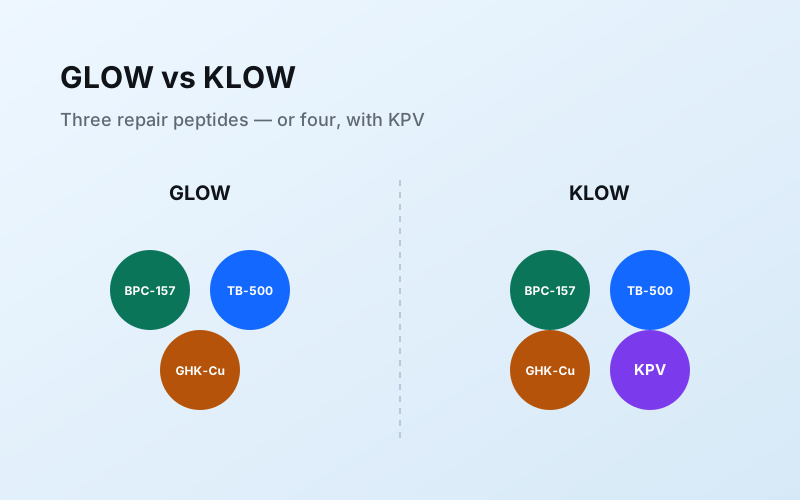
The short answer: GLOW and KLOW are both lyophilized research peptide blends, and they share three of the same peptides — BPC-157, TB-500, and GHK-Cu. KLOW adds a fourth, KPV. So the whole difference comes down to one peptide and what it brings.
Side-by-side comparison
| GLOW | KLOW | |
|---|---|---|
| Peptides | 3 | 4 |
| Composition | BPC-157, TB-500, GHK-Cu | BPC-157, TB-500, GHK-Cu, + KPV |
| Total blend | 70 mg | 80 mg |
| Research focus | Tissue repair | Tissue repair + inflammation modulation |
| Format | Single lyophilized vial | Single lyophilized vial |
| Product page | GLOW | KLOW |
The three peptides they share
- BPC-157 — a pentadecapeptide studied for soft-tissue repair and angiogenesis.
- TB-500 — a Thymosin Beta-4 fragment studied for cell migration and tissue repair.[1]
- GHK-Cu — the copper tripeptide studied for matrix remodeling and collagen.
All three are studied largely around building and repairing tissue. In GLOW they sit together in one vial at a fixed ratio, which is the appeal of a blend: a repeatable, pre-mixed combination instead of measuring three components by hand.
The one peptide that sets KLOW apart: KPV
KPV is a tripeptide — lysine-proline-valine — that forms the tail end of the hormone α-MSH. Unlike the repair-focused trio, KPV's research interest is anti-inflammatory signalling: studies have looked at its reported ability to dampen inflammatory pathways, notably in models of gut inflammation, without the broad immune suppression of larger molecules.[2] Adding it shifts KLOW's overall emphasis from pure repair toward repair plus inflammation modulation.
Which one for which research question?
The choice is about scope, not "better" or "worse":
- Reach for GLOW when the question is about the three-peptide repair core on its own, and the extra variable of KPV would only complicate interpretation.
- Reach for KLOW when an inflammation-modulating element belongs in the same model — for example, protocols where repair and inflammatory signalling are being looked at together.
Because both are fixed blends, neither lets you tune one component independently. Research that needs to isolate a single peptide is better served by ordering that peptide on its own; see the note on blends below.
Blends vs. single peptides
A blend's ratio is set in the vial — convenient and repeatable, but not adjustable component-by-component. If a study needs to vary one peptide against the others, single peptides give that control. If it treats the combination as one defined unit, the blend format is simpler and more consistent. None of these components, nor either blend, is an approved drug; all are research materials.
Practical details in the lab
Both GLOW and KLOW ship as a single lyophilized blend, stored cold and dry, with prompt use after reconstitution (see reconstitution and storage stability). Both ship domestically within Canada, so an order never sits at customs. For the full component breakdowns, see What Is GLOW? and What Is KLOW?, or go straight to the GLOW and KLOW product pages.
For research use only. Not for human or veterinary use. This article is educational and summarizes published literature; it does not describe or recommend any use in humans and is not medical advice.
References
- Goldstein AL, Hannappel E, Kleinman HK. "Thymosin β4: actin-sequestering protein moonlights to repair injured tissues." Trends in Molecular Medicine. PubMed.
- Dalmasso G, Charrier-Hisamuddin L, et al. "PepT1-mediated tripeptide KPV uptake reduces intestinal inflammation." Gastroenterology. PubMed.
- National Center for Biotechnology Information. "GHK-Cu compound summary." PubChem. pubchem.ncbi.nlm.nih.gov.